
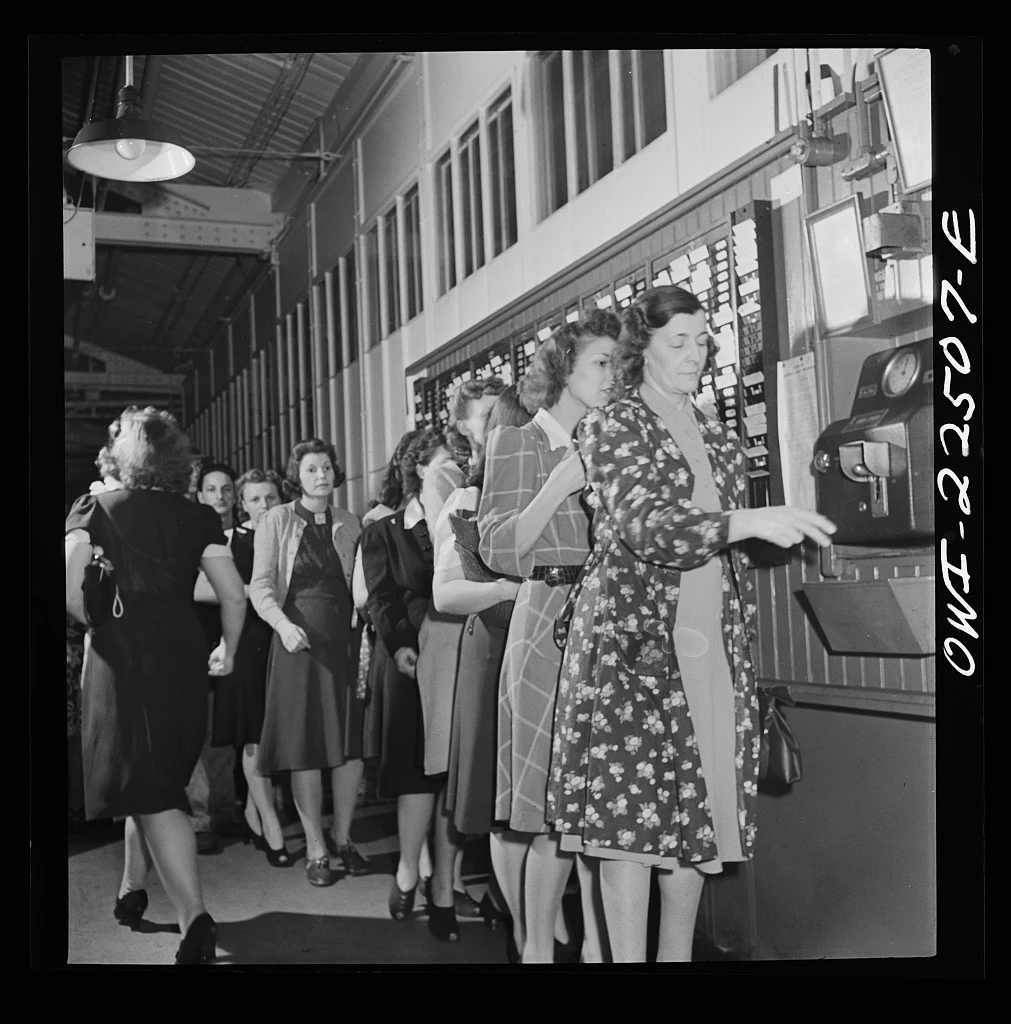
Time cannot literally be transferred. Nobody receives the eight hours that somebody else has spent in a workshop, hospital or office. An employment relationship does, however, transfer authority: for an agreed duration, task, organisation and contract determine what a person is to do, where they must be and often the pace at which they act. Precisely because a lifetime cannot be sold, this exchange is so consequential. Payment often covers not only a result, but also a person's bound presence.
How did the clock become the measure of work?
The historian E. P. Thompson described a shift during English industrialisation from more task-oriented rhythms of work towards a discipline of measured time. His account is not a simple story in which a machine suddenly extinguished all freedom. People measured hours long before the factory, and agriculture was never free of harsh rhythms. Yet the mechanical clock enabled a particular abstraction: very different activities could be charged, compared and controlled in the same unit.
In task-oriented work, milking ends when the animals have been cared for, or a repair when the mechanism runs again. In time-oriented work, the obligation ends at a set hour. That can create freedom because a boundary becomes visible. It can also intensify control because not only the result counts; every interruption may appear as a lost minute. The clock is neither oppressor nor liberator. It makes claims precise, which is exactly why it matters who is allowed to make them.
The limits of working time were never merely a technical matter. The International Labour Organization's first Convention set a maximum of eight hours a day and 48 hours a week in the industrial undertakings it covered in 1919, with specified exceptions. This formula did not divide the day by nature into eight hours of work, eight of rest and eight of sleep. It was the result of a political struggle over how much of a person's time an employer may claim.
The argument does not end at the factory gate. On-call duty, shifting rosters, unpaid care and the smartphone after hours show that the placement, predictability and interruptibility of hours also determine freedom. Two people may work equally long and still retain very different degrees of control over the rest of their day.
The body does not read a duty roster
The time clock knows only duration and deadline. The human body also knows phases. Light and darkness synchronise circadian rhythms that help organise sleep, wakefulness and numerous bodily processes. An hour at three in the morning is therefore not biologically the same as an hour at three in the afternoon, even if both look identical on a payslip.
A systematic review of people newly moving into shift work found that sleep and mental health worsened on average after shift work began. The results do not say that every night shift makes every person ill. Tolerance differs, and health outcomes depend on the roster, recovery, life circumstances and many other factors. But the research corrects an economic simplification: working time is not merely a quantity. Its place in the day intervenes in a living rhythm.
Sheer duration also has a bodily limit. WHO and ILO estimated that 745,000 deaths from stroke and ischaemic heart disease worldwide in 2016 were attributable to long working hours. In the underlying analyses, working at least 55 hours a week was associated with higher risks than working 35 to 40 hours. Such global models cannot predict the fate of an individual person. They do show, however, that authority over working time distributes not only income and leisure, but also health risks.
Is work, then, life lost?
No. Work can be an object of personal devotion. It can provide skill, community, recognition and a rhythm to the day. Marie Jahoda described these non-financial functions of employment as early as 1981. A later study using a representative German sample found, among other things, more time structure, social contact, activity and experience of a collective purpose among employed people than among those without employment.
That does not make bad or coerced work good. It merely prevents an overly convenient calculation in which every working hour is subtracted from life itself. Someone who repairs a watch, teaches a child or cares for another person may realise something of their own precisely in work. Work is not automatically somebody else's time, and leisure is not automatically one's own. A free evening can also be ruled by loneliness, financial worries or obligations.
What matters more than the labels is scope for action. A systematic review of control over one's working time found solid evidence of a positive association with the fit between work and the rest of life. The evidence for health and wellbeing was more cautious and allowed only limited causal conclusions. This qualification matters: autonomy is not a wellness word that neutralises every burden. But it makes a difference whether a person plans a demanding hour themselves or whether somebody else claims it from them at short notice.
What is actually being sold?
A contract of employment does not buy a segment of spacetime. It arranges rights and duties within a segment of human life. That sounds legally sober, but it is existentially concrete. Anyone who commits an hour forgoes other possibilities during that hour. Money may open later possibilities, provide security and compensate other people's time. It cannot return the hour already spent.
Price alone is therefore not a complete measure of fair work. Duration, pace, predictability, meaning, health and the ability to say no matter as well. A highly paid but wholly directed week may dispossess a person of time more deeply than lower-paid work with a rhythm of their own. Conversely, personal fulfilment does not dissolve the claim to limits. People who love their work need no less protection from its boundlessness.
The decisive question is therefore not whether work costs lifetime. Everything costs lifetime. What matters is who can determine duration, placement and purpose, who receives the return and who is allowed to reject an unreasonable demand. Our time never belongs to us alone because we live with and for others. But a fair society must justify the point at which shared time becomes time commanded by somebody else.
Sources
E. P. Thompson, Time, Work-Discipline, and Industrial Capitalism, Past & Present 38 (1967)
International Labour Organization, Hours of Work (Industry) Convention, 1919 (No. 1)
National Institute of General Medical Sciences, Circadian Rhythms
Rachael Harris et al., Sleep, Mental Health and Physical Health in New Shift Workers Transitioning to Shift Work, Sleep Medicine Reviews 75 (2024)
World Health Organization and International Labour Organization, Long Working Hours Increasing Deaths from Heart Disease and Stroke (2021)
Marie Jahoda, Work, Employment, and Unemployment, American Psychologist 36 (1981)
Karsten I. Paul and Bernad Batinic, The Need for Work, Journal of Organizational Behavior 31 (2010)
Hylco H. Nijp et al., Systematic Review on the Association Between Employee Worktime Control and Work-Non-Work Balance, Health and Well-Being, and Job-Related Outcomes, Scandinavian Journal of Work, Environment & Health 38 (2012)