
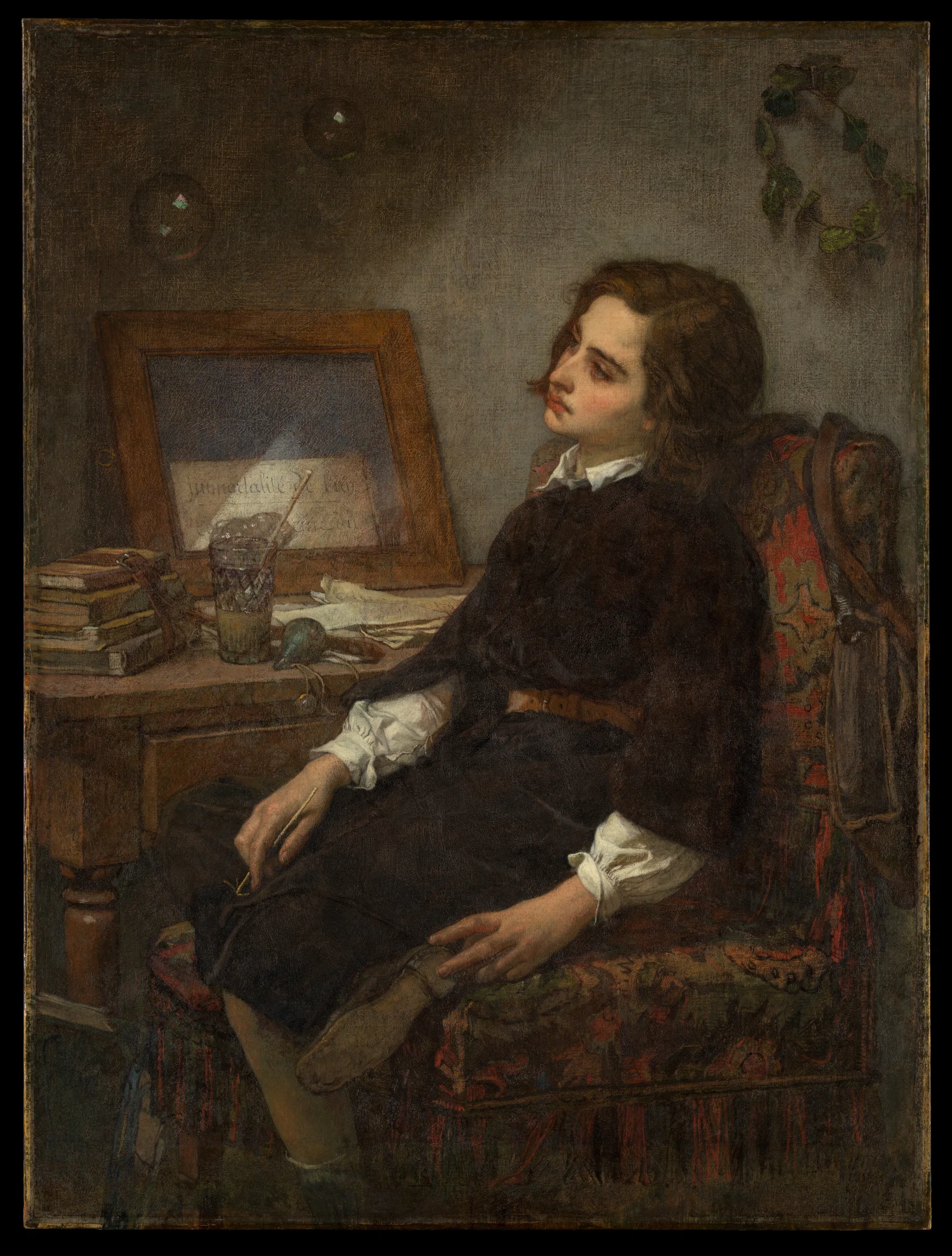
A clock can show that an hour has passed. It cannot decide whether that hour was fulfilling. Boredom arises precisely in this distance between measured and experienced time.
Two kinds of time in the same minute
Physics treats a second with impressive rigour. In the International System of Units, it is defined through 9,192,631,770 periods of a particular radiation of the caesium-133 atom. Precise atomic clocks can realise this unit without asking whether a kiss, an operation or time spent on hold is taking place. Even this time is not a universal beat in relativity. A clock measures proper time along its path through spacetime. Motion and gravity affect how different clocks run relative to one another.
That may sound as if it must also explain why a minute feels long or short. But this would confuse two questions. Relativistic effects change the comparison between physical clocks. Boredom does not alter the caesium frequency or curve spacetime. It changes our judgement of a duration. The second in the laboratory and the dragging minute in the waiting room are not rival laws of nature. They answer different questions.
Nor does the brain contain a little central clock that stamps experiences neutrally. Researchers distinguish, among other things, between prospective timing, in which we attend to a duration still in progress, and retrospective timing, in which we reconstruct a past duration from memory. Attention, emotion, bodily state and remembered events interact differently in each case. A journey can therefore pass quickly in the moment yet seem long in retrospect, while uneventful waiting stretches as it happens and later disappears almost without a trace.
What happens when time refuses to pass?
Psychologists John Eastwood, Alexandra Frischen, Mark Fenske and Daniel Smilek describe boredom as an unpleasant state in which a person wants to engage in a satisfying activity but cannot successfully bind their attention to it. The problem is not that nothing exists. What is missing is an activity that feels accessible and meaningful in that moment.
This explains why even a full diary can be boring. A monotonous task, a meeting in which one has no agency, or aimlessly switching between short videos fills time without truly holding attention. Conversely, an outwardly uneventful afternoon can be rich when a question, a workpiece or a conversation makes a claim on us.
Experiments on time perception make this difference measurable. In a study by Natalia Martinelli and Sylvie Droit-Volet, attention to time proved an important predictor of duration judgements for short intervals. For stretches lasting several minutes, experienced boredom was particularly closely associated with the feeling that time had slowed and with overestimating duration.
The everyday experience of repeatedly checking the clock is therefore not merely a metaphor. As soon as an activity fails to carry our attention, the remaining duration can itself become the object of attention. Every check confirms that the anticipated end has not arrived. The clock measures steadily, and for that very reason becomes an instrument of subjective extension.
Shane Bench and Heather Lench also found that boredom can prompt a search for new experiences. Those experiences need not be more valuable. Because the state is unpleasant, mere variation can become attractive, even when it is negative. Boredom is therefore not a reliable adviser. It is closer to an alarm without directions: something is wrong in the relationship between attention, activity and possible action.
Why does finitude not cure boredom?
Knowledge of death is abstract. The next free afternoon is concrete. Knowing that all our days are numbered does not supply content for this particular day. Someone bored in a waiting room has not forgotten finitude. They simply cannot find a way, at that moment, to shape open time as their own.
More than that, the thought of scarcity can itself become coercive. If every hour is irretrievable, every hour is expected to be useful, intense or memorable. Life then comes to be managed like a scarce account. Rest must produce recovery, a walk must generate health, a conversation must maintain a relationship. Even free time is placed under pressure to yield a return. The fear of wasting time creates a second authority that watches over the present.
This is not the same as indifference. A finite life demands choices precisely because not every possibility can be realised. But no finding in physics or psychology supplies a formula for which possibility is right. Finitude does not automatically create meaning. It only makes visible that choosing one possibility excludes others.
Who owns an empty hour?
Perhaps boredom is therefore more political than it first appears. Not everyone can respond to its signal. A child in a lesson, a worker on an assembly line or a patient in a waiting room cannot simply leave. The tormenting slowness of an hour can indicate that someone is required to be present without being able to determine the purpose or end of that presence. This is no longer only a matter of attitude, but of control.
Yet a world without boredom would also be suspect. The alarm can set something in motion. When nothing outside us binds our attention, it must either remain with the emptiness or seek a new object. Play, daydreams and unexpected connections can emerge from this search. Boredom is not itself creativity. But it can be the closed door before which thought begins to imagine another exit.
Small experiments give this possibility some substance without turning it into a law. Sandi Mann and Rebekah Cadman first gave adults monotonous tasks involving telephone numbers, then asked them to find unusual uses for everyday objects. After the boring activities, participants performed better than control groups on these divergent-thinking tasks. The studies measured a narrowly defined form of creative idea generation under artificial conditions, not the creation of a novel or an invention. They show a possibility, not a guaranteed burst of creativity.
An experiment by Benjamin Baird and colleagues separates boredom even more carefully from the process that may follow it. Participants first worked on creativity tasks and then took a break. Those who performed an undemanding activity during the break, one in which their minds frequently wandered, later found better solutions to previously encountered problems than people given a demanding task, simple rest or no break. This supports the idea of creative incubation: a problem can continue to work in thought while conscious attention is no longer fixed on it. But something must already exist to incubate. External emptiness cannot replace experience, craft or a question that has first been asked.
Silence and boredom are not the same. Silence is an external condition. Whether it gives rise to calm, discomfort, memory, imagination or boredom remains open. Its particular value lies precisely in the fact that the next inner state has not yet been prescribed from outside.
This is what makes rapid streams of stimulation so interesting. A podcast starts in the car, music plays while we cook, a feed opens in the queue. None of these media is inherently an enemy of thought. A song can open up ideas; a voice in our headphones can stay with us for years. What matters is whether we want to listen or whether every unoccupied moment must be filled reflexively, before a thought of our own has finished its first sentence.
Katy Tam and Michael Inzlicht examined this escape in seven experiments involving a total of 1,223 people. Boredom led participants to switch between videos or fast-forward more often. They expected this to make them less bored. In several experiments the opposite occurred: switching increased boredom and reduced attention, satisfaction and experienced meaning. Results involving articles and non-student samples were less clear. The study therefore does not prove that social media fundamentally robs us of creativity. It shows something more precise: the attempt to flee boredom can prevent the very depth of engagement that allows a stimulus to become interesting.
With children, this can quickly become the well-intentioned claim that they simply need to be bored more often. But prescribed emptiness is not yet freedom. A correlational study of six- and seven-year-olds found an association between more time in less-structured activities and better performance on tasks in which children had to organise goals and actions for themselves. The direction of cause remained open. Perhaps unstructured time strengthens self-direction. Perhaps adults are more likely to grant such freedom to children who are already good at occupying themselves.
The reasonable conclusion is not to make a show of leaving children without attention. What matters is a safe space, materials, time and the absence of a finished programme. A child who builds a city from cardboard boxes has not efficiently eliminated boredom. They have made a world of their own from an hour that was initially unoccupied. An adult who endures a car journey without audio may not have a great idea. But a thought receives the rare opportunity not to be replaced by somebody else's thought after three seconds.
Silence is therefore not a creativity tool with a calculable return. As soon as we schedule it solely to produce a good idea, it too is placed under pressure to perform. Its value is more radical: in external emptiness, it has not yet been decided what will possess our attention next. An open hour can feel empty before it becomes our own. Sometimes the prescribed activity must first fall silent before another question can be heard.
Finitude makes time unrepeatable. It does not make time meaningful by itself. Boredom exposes that difference. It asks not only: what should I do? It asks a deeper question: which possibilities in this hour do I recognise as mine at all? Who owns our time is not decided by whether every minute is filled. It is decided by whether we can relate to time without merely having to kill it.
Sources
Bureau International des Poids et Mesures, SI base unit: second
Markus Pössel, Einstein Online, How time is made
Albert Tsao et al., The Neural Bases for Timing of Durations, Nature Reviews Neuroscience 23 (2022)
John D. Eastwood et al., The Unengaged Mind: Defining Boredom in Terms of Attention, Perspectives on Psychological Science 7 (2012)
Natalia Martinelli and Sylvie Droit-Volet, Judgment of Duration and Passage of Time, Scientific Reports 12 (2022)
Shane W. Bench and Heather C. Lench, Boredom as a Seeking State, Emotion 19 (2019)
Sandi Mann and Rebekah Cadman, Does Being Bored Make Us More Creative?, Creativity Research Journal 26 (2014)
Benjamin Baird et al., Inspired by Distraction, Psychological Science 23 (2012)
Katy Y. Y. Tam and Michael Inzlicht, Fast-Forward to Boredom, Journal of Experimental Psychology: General 153 (2024)
Jane E. Barker et al., Less-Structured Time in Children's Daily Lives Predicts Self-Directed Executive Functioning, Frontiers in Psychology 5 (2014)