
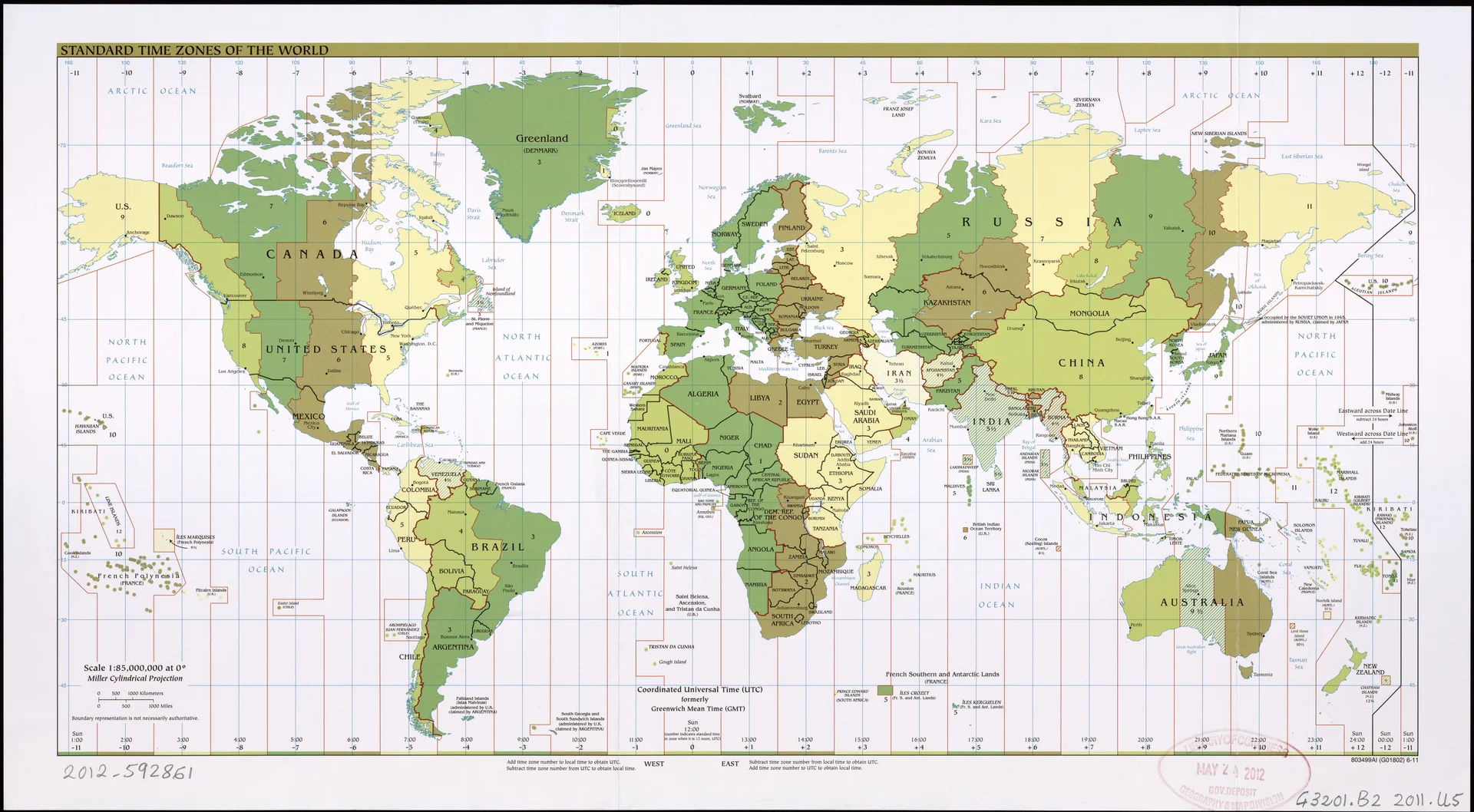
When people and messages travelled slowly, local time was practical. A town set its mean time by the Sun at its own longitude. Because Earth turns through 360 degrees in 24 hours, one degree of longitude corresponds to four minutes of time. Nearby places could therefore differ by a few minutes without troubling daily life. A timetable crossing many towns turned those same minutes into a problem.
When networks needed a common time
In Britain, most railway companies had adopted Greenwich Mean Time by the 1840s. Telegraph signals later distributed that reference quickly across the country; Greenwich time became the legal standard there in 1880. North America followed a different course. On November 18, 1883, the railways changed their operations to zoned time. Many cities followed, but the American zones did not become federal law until 1918. Railway time, civic time and legal time were not identical from the beginning.
The pressure did not come from trains alone. Telegraphy, weather observations, navigation and trade all needed to place distant events in an unambiguous order. Standard time was therefore less a new discovery about nature than an infrastructure decision: which clock should govern a connected network?
What the 1884 conference actually decided
At the International Meridian Conference in Washington, 41 delegates from 25 nations met to establish common references. They recommended Greenwich as the shared prime meridian and a universal day for purposes where it would be useful. The resolution explicitly said this should not interfere with local or other standard times. The conference did not divide Earth by decree into the political time zones we know today.
Countries adopted shared reference points at their own pace. In 1893, the German Empire made mean solar time at 15 degrees east of Greenwich its legal time; the law took effect on April 1. France did not align its legal time with the Greenwich reference until 1911. Other boundaries and exceptions continued to appear, disappear and move.
The same time does not mean the same display
The world never began to show the same hour everywhere. Instead, it learned to relate different hours to one reference. Clocks in Berlin, Delhi or New York no longer disagree accidentally by local minutes; they differ deliberately according to agreed zones. On a world map, their borders are rarely straight. Geography supplies the longitudes, but societies decide which common clock is useful in daily life.
The crucial achievement of standard time is not uniformity. It is translatability. Once we know which measure a clock refers to, a moment can cross a border without losing its meaning.
Sources
Royal Museums Greenwich, History of the Royal Observatory
Smithsonian National Museum of American History, Synchronizing Time: Time Zones
International Meridian Conference, Protocols of the Proceedings (1884)
Physikalisch-Technische Bundesanstalt, Die Vermessung der Zeit
French Republic, Law of March 9, 1911