
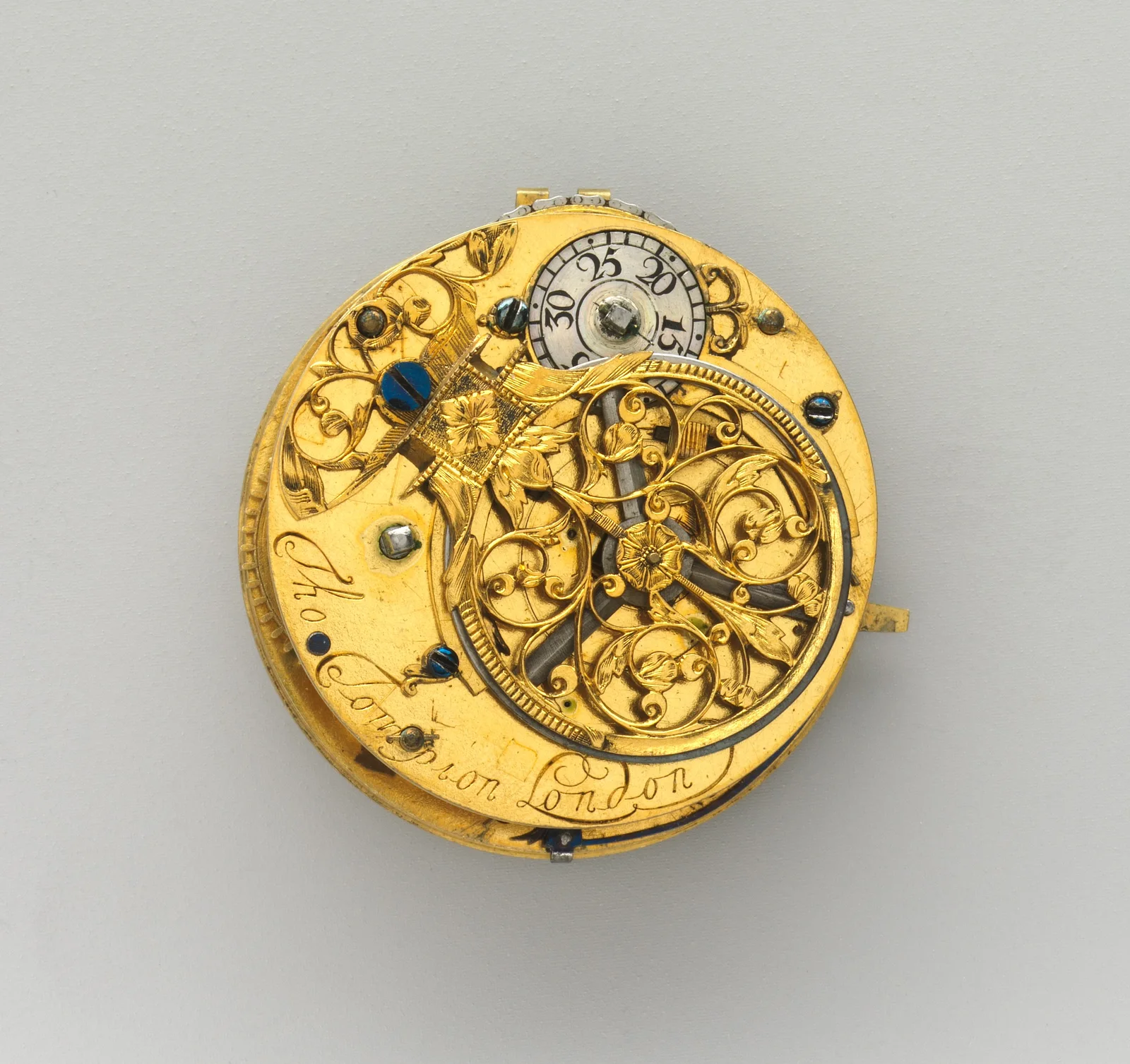
A mechanical watch does not keep a finished second inside its movement. It makes its beat anew. The mainspring drives the wheel train; the escapement releases that train in steps while returning energy to the balance. The balance spring pulls the displaced balance wheel back. Together they form an oscillator whose swings divide the motion of the hands.
The movement in the photograph was made by Thomas Tompion in 1682 or 1683. The Met describes a three-wheel going train driven by a mainspring and fusee, with a verge escapement, three-armed balance and balance spring. The construction is historical; the underlying principle - stored energy metered by a mechanical timekeeper - remains current.
What sets the rate?
In a simplified model, the duration of each swing depends on two things: the balance wheel's moment of inertia and the restoring effect of the spring. If the swing becomes slightly shorter, the movement counts too many within 24 hours and the watch gains. If it becomes longer, the watch loses.
A real balance and spring are not an ideal model. The escapement delivers impulses, bearings dissipate energy, the spring is shaped and fixed at two points, and no balance wheel is mathematically perfect. The question is therefore not only whether the average daily rate is right, but how steadily the oscillator behaves as its conditions change.
Why does position change the rate?
Gravity does not make time itself pass differently here. It makes small mechanical imperfections matter differently in different positions. Contact and friction at the balance pivots change; a slight imbalance, or a spring that does not “breathe” perfectly concentrically, acts differently in horizontal and vertical positions. Precision measurements by Horace A. Bowman at the US National Bureau of Standards traced positional differences to changing friction and gravitational effects on the spring.
What do temperature, power and friction do?
Temperature changes material dimensions and the elasticity of a balance spring. In tests for the Bureau of Standards, Ralph E. Gould found clearly measurable temperature-rate curves; Elinvar springs and monometallic balances greatly reduced the temperature errors of the watches then under study. Modern materials can reduce such effects further, but a watch remains an assembly of physical materials.
The driving torque, and therefore the amplitude of the balance, also changes as the mainspring runs down. A perfectly isochronous oscillator would keep the same period; real springs and escapements only approach that ideal. Ageing oil, dirt or wear introduce further changes in frictional loss. There is no safe shortcut such as “more friction always makes a watch slow”: the result comes from the interaction of amplitude, spring and escapement.
Regulation means measuring a watch's rate and deliberately adjusting its effective beat. A professional assessment considers several positions together with rate, beat error and amplitude. Dirt or wear cannot responsibly be regulated away; they call for servicing first. A good mechanical watch does not abolish physics. Its quality lies in making physical influences small, repeatable and manageable.
Sources
The Metropolitan Museum of Art, Pair-case watch, Thomas Tompion, 1682–83
Ralph E. Gould, Comparative Performance of Watches with Elinvar and with Steel Hairsprings, Bureau of Standards Journal of Research 12 (1934)
Horace A. Bowman, Determination of Very Small Changes in Rate Over Intervals of Several Days in Mechanical Timepieces, Journal of Research of the National Bureau of Standards 45 (1950)