
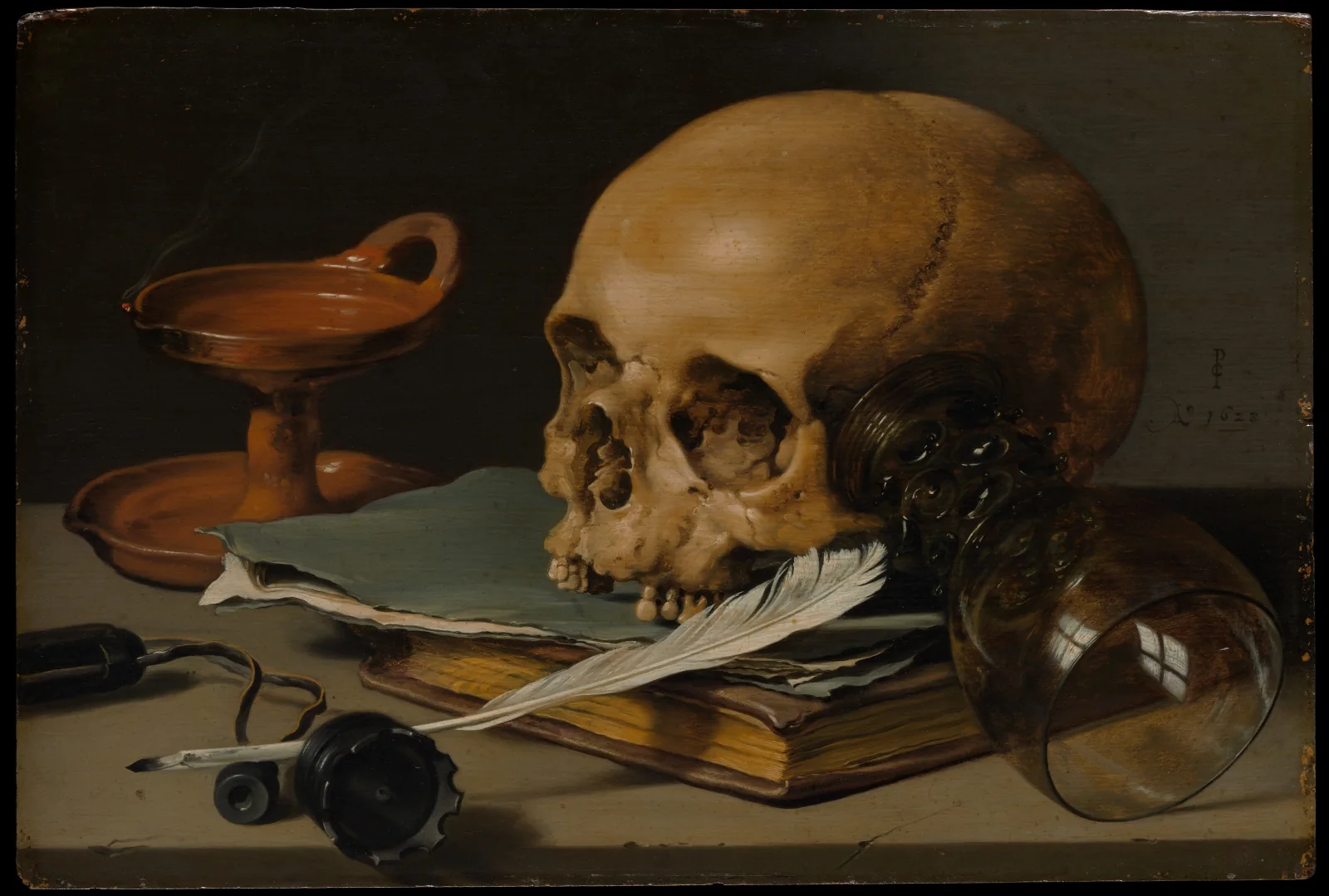
Nothing moves in Pieter Claesz's still life of 1628. A skull lies beside a writing quill, a glass has toppled, and the flame of an oil lamp is dying. The Metropolitan Museum interprets these very objects as signs of life's brevity. The painted instant stands still, yet it is entirely about passing away.
How can a motionless picture show time?
Claesz does not paint the process itself but its traces and expectations. The glass must once have stood upright; the flame will soon be gone; the quill and book point to thoughts that may outlive a person. The viewer supplies the before and after. Time appears not as painted movement but as a relationship between what has already happened and what must follow.
Nor does the picture try to defeat transience. It makes transience visible. The fact that the work can still be seen today does not weaken that claim. On the contrary, a painting from 1628 carries its own history of preservation. Its duration is different from the human lifetime it addresses.
When does duration become a material?
In time-based art, time does not reside only in the subject. The Smithsonian defines such art as work with a specific duration, including film, video, digital and web-based work, sound, performance, and installation. It unfolds in sequence. A single still can document it, but cannot replace it any more than one note contains a piece of music.
This art asks the audience for actual time. Sequence, repetition, pace, or interruption belong to its form. A viewer may linger before a painting or leave quickly; with a work that has a defined progression, leaving early literally changes what has been experienced.
What does preservation mean when technology expires?
Film stock ages, projectors disappear, and software and operating systems become unusable. Museums must therefore preserve more than a file or a device: they also document how a work is meant to look, sound, and behave. The Guggenheim describes migration and emulation as possible strategies for computer-based art, accompanied by the question of how much change artistic integrity can allow.
Here old and new art meet. Neither exists outside time. They represent time, give it a form, and become subjects of decision when they are preserved. Art does not make time durable like a possession. It reveals that endurance is always a shaped relationship between change and fidelity.
Sources
The Metropolitan Museum of Art, Pieter Claesz: Still Life with a Skull and a Writing Quill
Smithsonian Institution, Time-based Media & Digital Art
Solomon R. Guggenheim Museum, The Conserving Computer-Based Art Initiative