
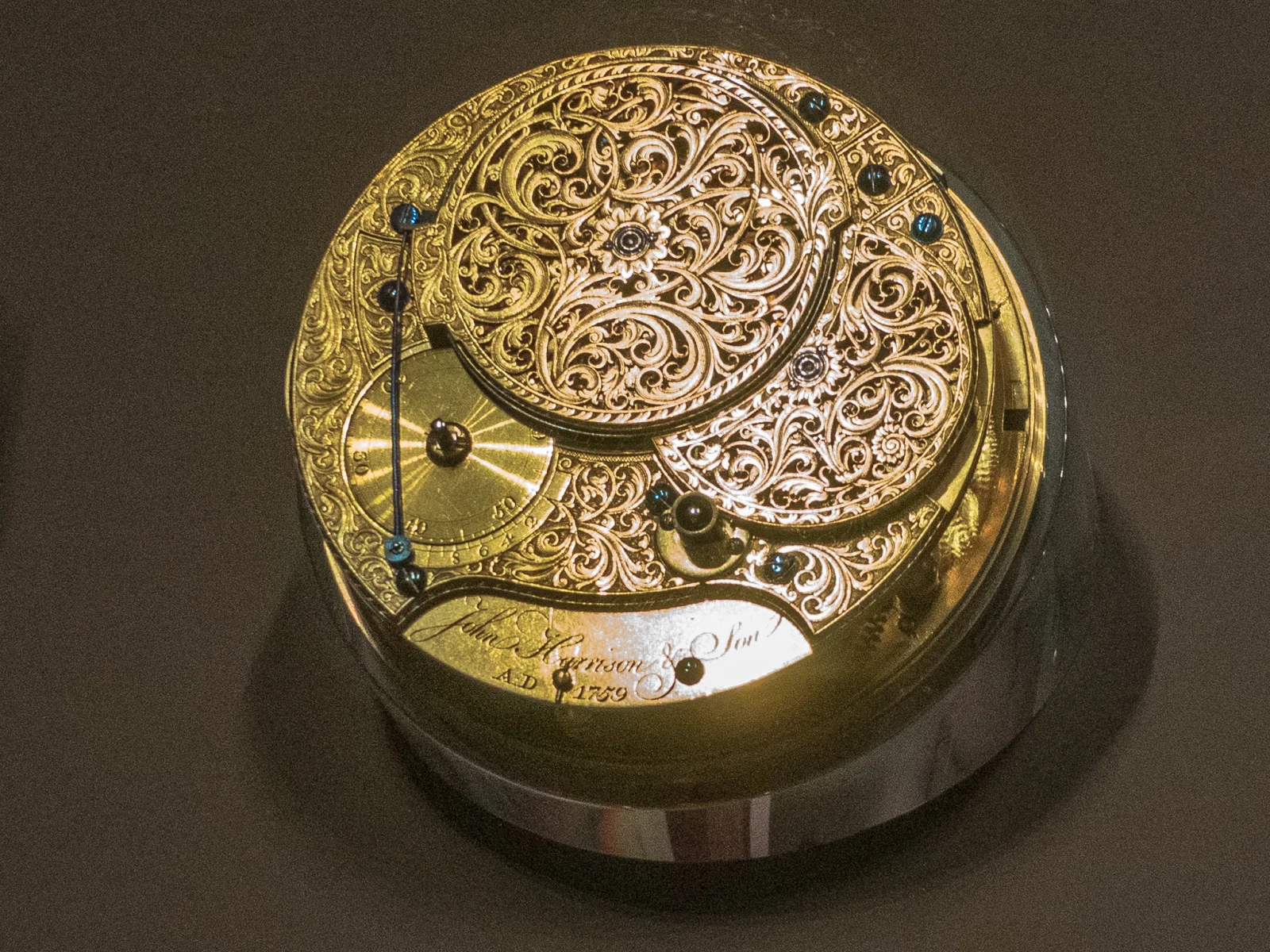
Mariners had long been able to derive latitude from the height of the Sun or stars. Longitude lacked an equally dependable east–west reference. A clock could fill that gap - not because it knew its position, but because it carried a second time aboard.
A Clock Does Not Measure a Place
A navigator determined local noon from the Sun's highest point and compared it with the time at a known reference meridian. The Earth turns through 360 degrees in 24 hours, or 15 degrees per hour. If the reference clock reads 2 p.m. at local noon, the observer is 30 degrees west of that meridian. Four minutes of time difference correspond to one degree of longitude.
The arithmetic was manageable. Carrying reference time accurately for weeks was not. Motion, changing temperatures and friction made ordinary clocks too unreliable aboard ship. Every error in time became an error in position: a drift of four minutes already meant one degree of false longitude.
Harrison Proved That Time Could Travel
Britain's Longitude Act of 1714 offered as much as £20,000 for a sufficiently accurate method. The Board of Longitude assessed proposals, funded trials and demanded practical proof. John Harrison spent decades developing his H1 through H4 marine timekeepers. Completed in 1759, H4 was not a large pendulum clock but an oversized precision watch. Its stable, high-frequency balance proved to be the successful design.
H4 demonstrated that a reference time could survive an ocean voyage with sufficient accuracy. That did not immediately equip every vessel. One elaborate and expensive instrument still had to become reproducible, affordable, testable and usable in daily work at sea.
Longitude Was a System, Not a Single Object
Astronomers were developing the lunar-distance method at the same time: the angle between the Moon and selected stars served as a celestial clock, while tables supplied the reference. Timekeepers and astronomical methods did not instantly become opponents with one final winner. Mariners continued to combine new techniques with dead reckoning, observation and charts.
Later makers such as John Arnold and Thomas Earnshaw simplified and improved the marine chronometer until an exceptional proof could become a dependable navigational instrument. Harrison's decisive contribution is therefore more precise than the heroic tale of a lone inventor: his work showed that a clock could preserve the time of another place. Longitude emerged only when that carried time was compared with the local sky.
Sources
National Oceanic and Atmospheric Administration, What is longitude?
Royal Museums Greenwich, H4, object ZAA0037
Royal Museums Greenwich, Longitude found: Nevil Maskelyne and the lunar method
University of Cambridge, The longitude problem: 300-year-old archive opened to the world