
The Pisa pendulum story was recorded long after its supposed discovery. Galileo's pupil Vincenzo Viviani reports that around 1583 Galileo watched a lamp swing in Pisa Cathedral and compared its rhythm with his pulse. Pendulum isochronism is securely documented only in his 1602 letter. The lamp is therefore not verified as a discovery scene, but it poses a decisive question: how can recurring motion become a measure of time?
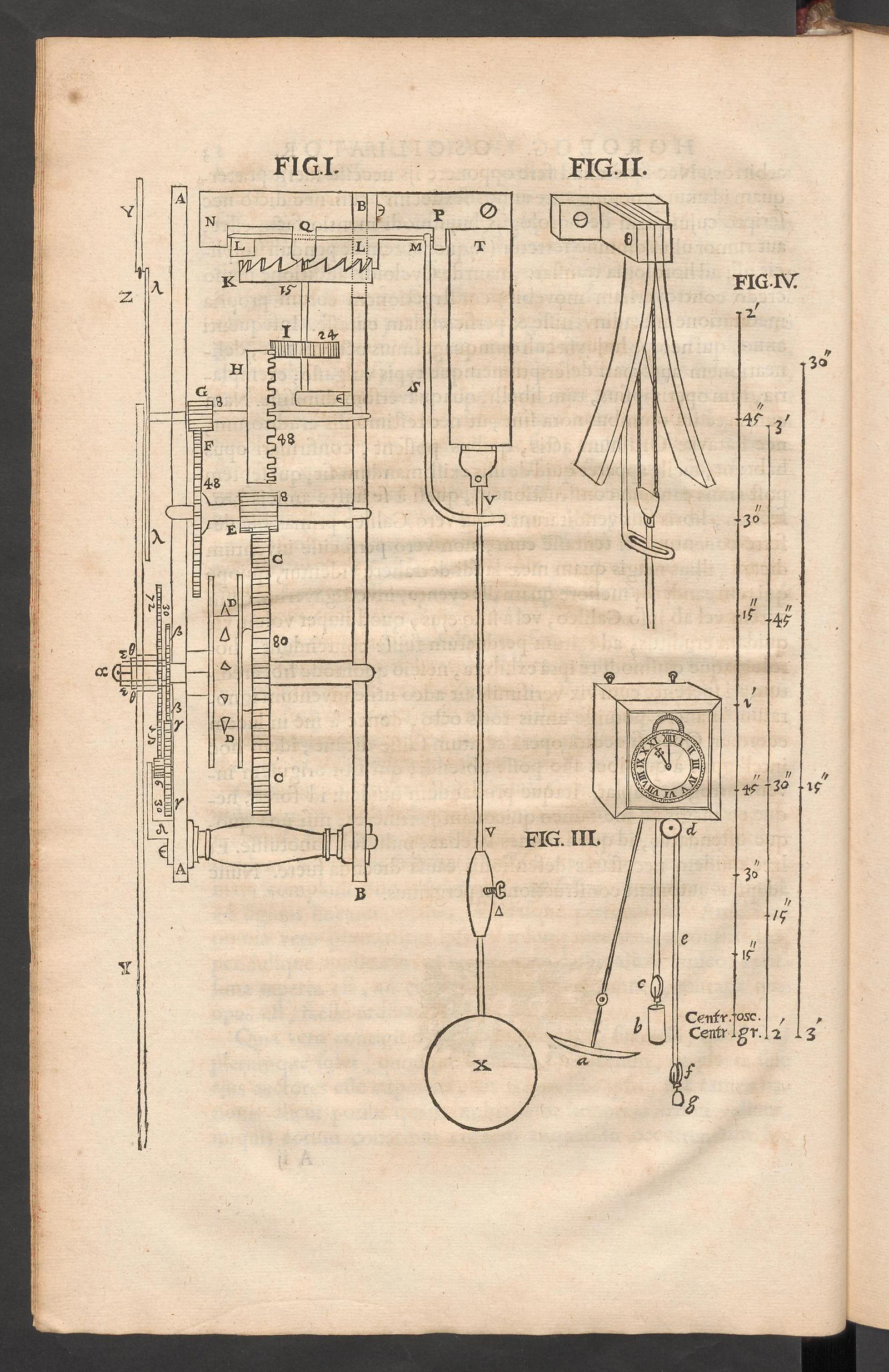
Galileo first studied pendulums apart from clocks and used them to compare intervals. In 1641, blind and late in life, he described to his son Vincenzo a mechanism joining pendulum and clock. Galileo died before it was built; Vincenzo began an unfinished version in 1649. Christiaan Huygens realised the first successful pendulum clock in 1656 and published its construction and theory in his 1673 Horologium oscillatorium.
Why does a pendulum swing almost uniformly?
For an ideal pendulum moving through a small angle, its period is approximated by T = 2π √(L/g). It depends on its length L and local gravitational acceleration g, but not on the mass of the bob. Within this approximation the pendulum is isochronous: small and slightly larger swings take the same time.
The word “approximation” matters. A real pendulum follows a circular arc; as the amplitude grows, its period becomes longer. The difference is small at a few degrees, but a clock accumulates it over tens of thousands of daily swings.
What disturbs the beat?
Air resistance and friction drain energy from the pendulum. Without a supply, its arc shrinks until it stops. The escapement therefore gives it a small impulse on each swing while also counting the beat for the wheel train. This intervention preserves the oscillation, but it is not invisible: the strength, timing and geometry of the impulse affect the motion. Precision comes from a controlled interaction, not from a freely swinging ideal.
Nor does the length remain constant. NIST gives 11.5 micrometres per metre and degree Celsius as a typical expansion coefficient for steel. An uncompensated steel pendulum lengthens in warmth, so the clock slows. A ten-degree rise costs a one-metre seconds pendulum roughly five seconds a day in the idealised calculation. Temperature compensation reduces this effect.
What does a pendulum measure?
Huygens knew that a circular arc is not perfectly isochronous. His cycloidal cheeks constrained the suspension thread to a path whose period is theoretically independent of amplitude. Later anchor escapements made smaller arcs possible and reduced circular error in a more practical way. Yet air, material, suspension and escapement remained real parts of the clock.
A pendulum does not make abstract time visible. It produces material events that we treat as equal intervals. Because the beat repeats, the coming moment seems comparable with the past. Yet this equality is not simply found in nature: length is fixed, amplitude limited, temperature compensated and rate compared with a reference.
Here lies the pendulum's philosophical appeal. It promises recurrence while showing that no recurrence is perfect. To measure is to choose an ideal, expose deviations and keep correcting them. A good pendulum clock keeps time not because nothing disturbs it, but because it responds to disturbance. How far clockmakers pursued this principle with astronomical regulators, Riefler clocks and Shortt's free pendulum deserves a separate essay. A future Wochenzeit article will explore precision pendulum clocks.
Sources
Christiaan Huygens, Horologium oscillatorium (1673), digitised by ETH Library Zurich
Museo Galileo, Galileo's life: the oscillations of the lamp and Viviani's account of applying the pendulum to the clock
Museo Galileo, Application of the pendulum to the clock
MIT OpenCourseWare, Classical Mechanics, Appendix 24A: Higher-Order Corrections to the Period for Larger Amplitudes
Allan R. Willms, Petko M. Kitanov and William F. Langford, Huygens' clocks revisited, Royal Society Open Science (2017)
National Institute of Standards and Technology, Engineering Metrology Toolbox: Temperature and thermal expansion
Science Museum Group, Early pendulum clock by Salomon Coster, c. 1657
Royal Museums Greenwich, Shortt Free Pendulum System No. 3