
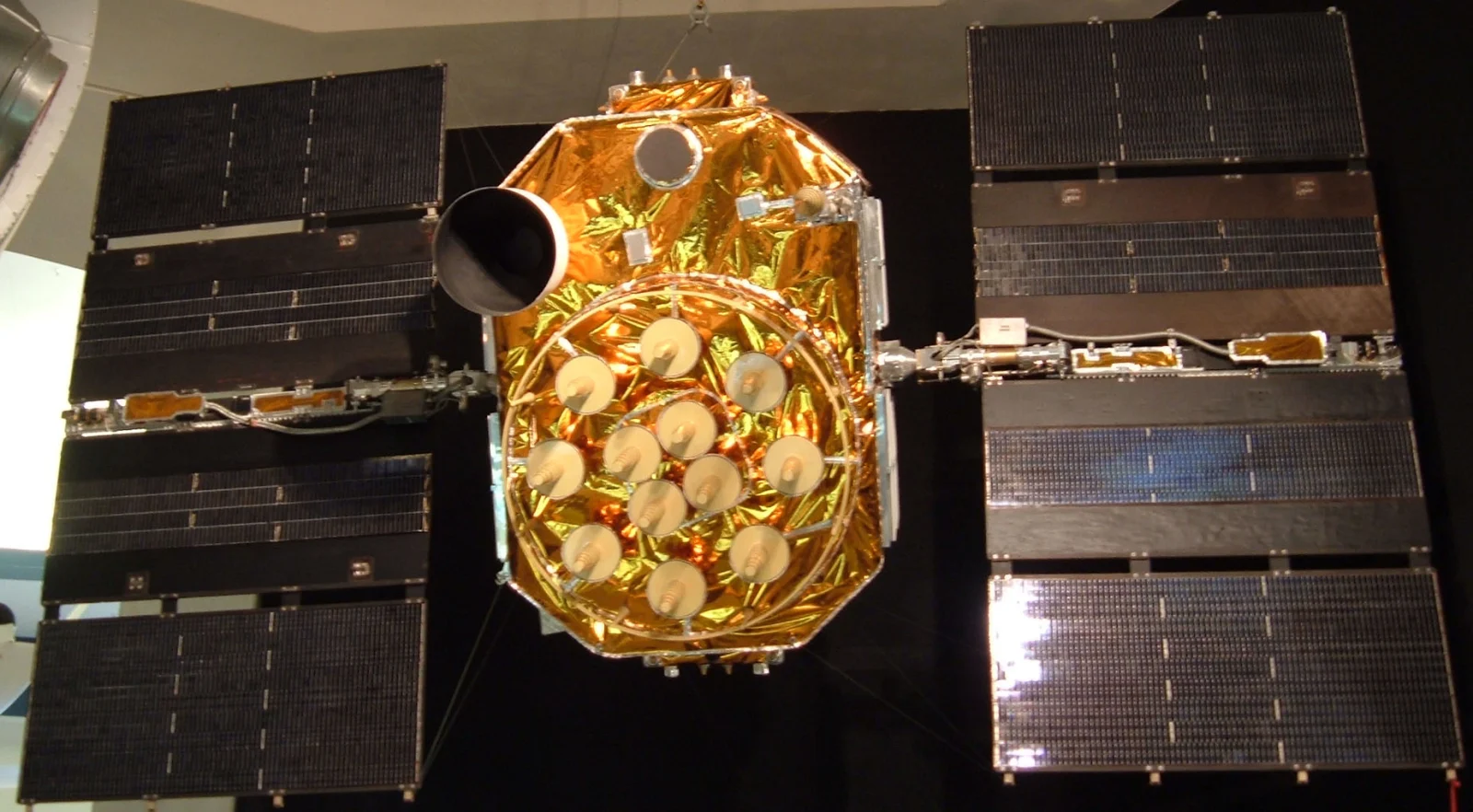
Each GPS satellite broadcasts when its signal was sent and where the satellite was at that moment. A receiver compares transmission and arrival times. Multiplying this travel time by the speed of light produces a measurement called a pseudorange. Signals from at least four satellites allow the receiver to solve for three spatial coordinates and, at the same time, the error of its own less accurate clock.
This turns a tiny timing error into a large spatial one. In a vacuum, one microsecond corresponds to almost 300 metres of light travel. Satellite atomic clocks must therefore do more than run steadily. Their rate must agree with the common GPS time scale even though they are moving rapidly and operating far above Earth's surface.
Why do clocks run differently in orbit?
Two relativistic effects pull in opposite directions. Special relativity says that a moving clock runs more slowly than a stationary one. For GPS satellites, this amounts to about 7 microseconds per day. General relativity says that clocks run faster in weaker gravity. In GPS orbit, this contribution is about 45 microseconds per day. The net result is that satellite clocks would gain roughly 38 microseconds per day relative to clocks on Earth.
Left uncompensated, that daily time difference represents more than eleven kilometres of light travel. It should not be read as an identically sized position error, because a position solution combines several satellites and other error sources. It does show the scale of the problem: metre-level accuracy would disappear very quickly.
Where is the correction made?
GPS does not solve the problem with one subtraction added at the end. The average effects of motion and gravity are built into the system as a fixed frequency offset. The GPS specification gives a fractional offset of −4.4645 × 10⁻¹⁰. This makes the clock reach the rate required for GPS time in its intended orbit.
A satellite orbit is not perfectly circular, either. Its speed and gravitational potential vary slightly along the orbit. IS-GPS-200N therefore specifies an additional periodic relativity correction. The receiver calculates it from broadcast orbital data and combines it with the satellite-clock correction coefficients carried in the navigation message.
Einstein is therefore not philosophical decoration added to GPS. His theories are present in the scale used to steer the clocks and in the calculations that turn signal travel times into a place. Satellite and receiver cannot rely on a naive second that is identical everywhere. They must calculate precisely how their different seconds fit together.
Sources
National Institute of Standards and Technology, Putting Einstein to the Test
Neil Ashby and Marc A. Weiss, Global Positioning System Receivers and Relativity, NIST Technical Note 1385 (1999)
U.S. Space Force / U.S. Coast Guard Navigation Center, IS-GPS-200N: Navstar GPS Space Segment/Navigation User Interfaces (2022)