
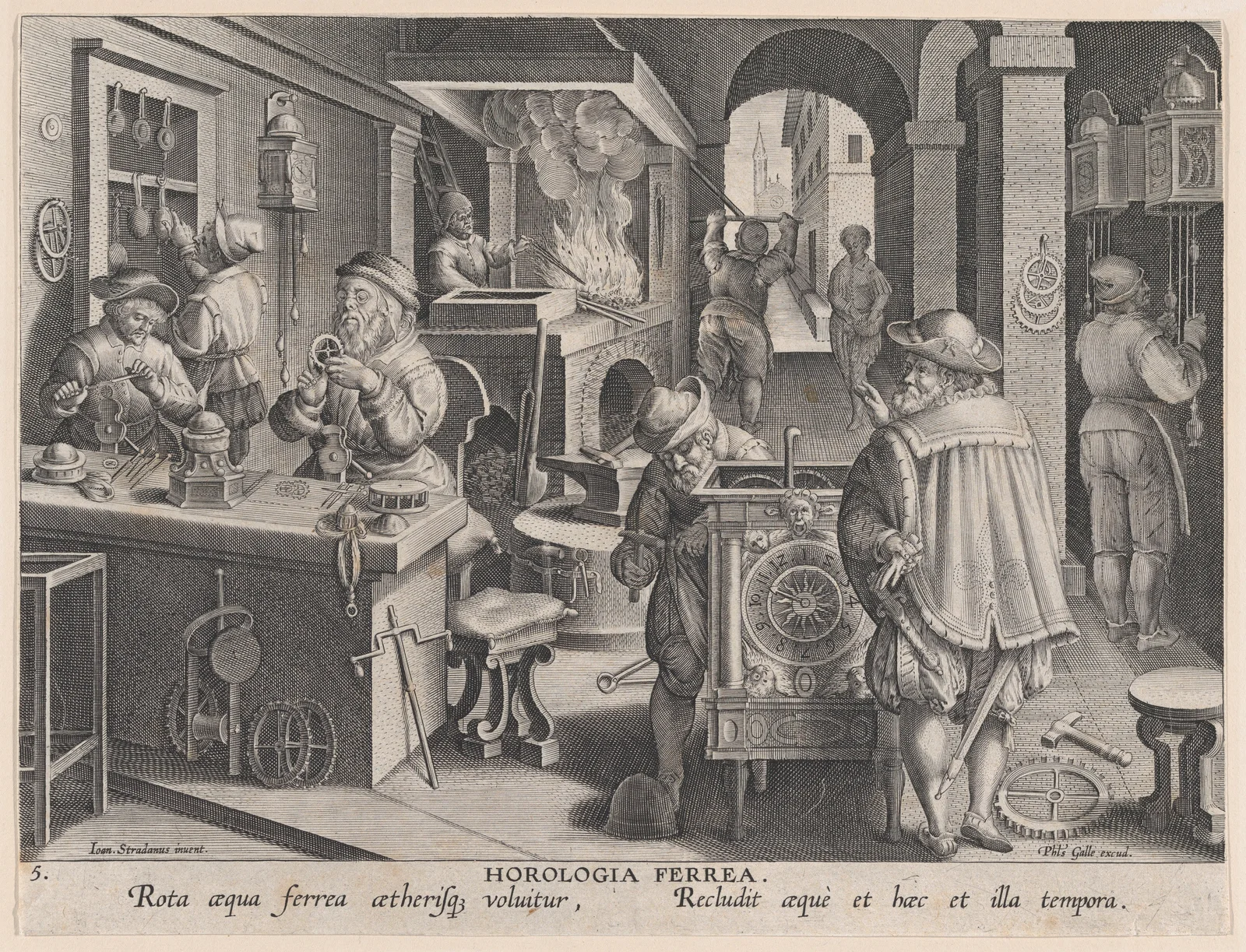
Many people are working at once in Theodoor Galle's engraving of a clockmakers' workshop. One examines a wheel, another files, while metal is worked in the background. Someone shaping a tiny tooth cannot follow every tool, sound and movement in the room with equal precision. Here, precision arises not from limitless perception but from selection.
Why do we not see everything before us?
Psychologists Marvin Chun, Julie Golomb and Nicholas Turk-Browne describe attention as a mechanism that selects among competing information, enhances what matters and sustains focus. This applies to external stimuli as well as internal contents such as memories or task rules. Attention is therefore not simply a supply running out like sand in an hourglass. It is primarily a way of assigning priority under limited processing capacity.
What is not selected does not vanish from the world. It may, however, remain outside what we consciously notice. Being visible and being perceived are not the same thing.
What does the “invisible gorilla” actually show?
Daniel Simons and Christopher Chabris asked participants to count ball passes in a video. Meanwhile, an unexpected and conspicuous figure - either a woman carrying an umbrella or a person in a gorilla suit, depending on the version - crossed the scene. Many participants did not notice it. Detection rates depended, among other things, on the task and the figure's similarity to the team being watched.
The experiment proves neither that people generally see their surroundings incorrectly nor that one activity is morally worth more than another. Its narrower and stronger finding is this: a task structures attention. Every focus therefore has a blind edge.
Must we now optimise every moment?
No. A limit of perception does not create a duty to concentrate without interruption. Thinking, remembering or quietly arranging a problem may themselves become objects of attention. Nor can anyone honour everything at once. Trying never to “lose” a moment would merely create another task that displaces something else.
A second can be measured again, but not repeated as the same moment. That is not a psychological rule for living. It is the starting point of a sober question: what should receive priority in this limited interval? Science can describe why selection is unavoidable. It cannot decide for us what deserves our attention.
Sources
Marvin M. Chun, Julie D. Golomb and Nicholas B. Turk-Browne, A Taxonomy of External and Internal Attention, Annual Review of Psychology 62 (2011)
Daniel J. Simons and Christopher F. Chabris, Gorillas in Our Midst: Sustained Inattentional Blindness for Dynamic Events, Perception 28 (1999)
The Metropolitan Museum of Art, The Invention of Clockwork, plate 5